
Michigan’s Special Education Transition Coordinators
A special education transition coordinator is a highly trained, caring, professional who helps individuals with disabilities, often aged 13 – 26, reach their fullest potential. They help individuals transition from student life to adulthood by identifying opportunities for students to gain the knowledge and skills needed for continuing education, independent living, work, and community participation, in preparation for adult life. Teachers in this fulfilling and rewarding career prepare, adapt, and deliver instructional materials to students who have a disability.
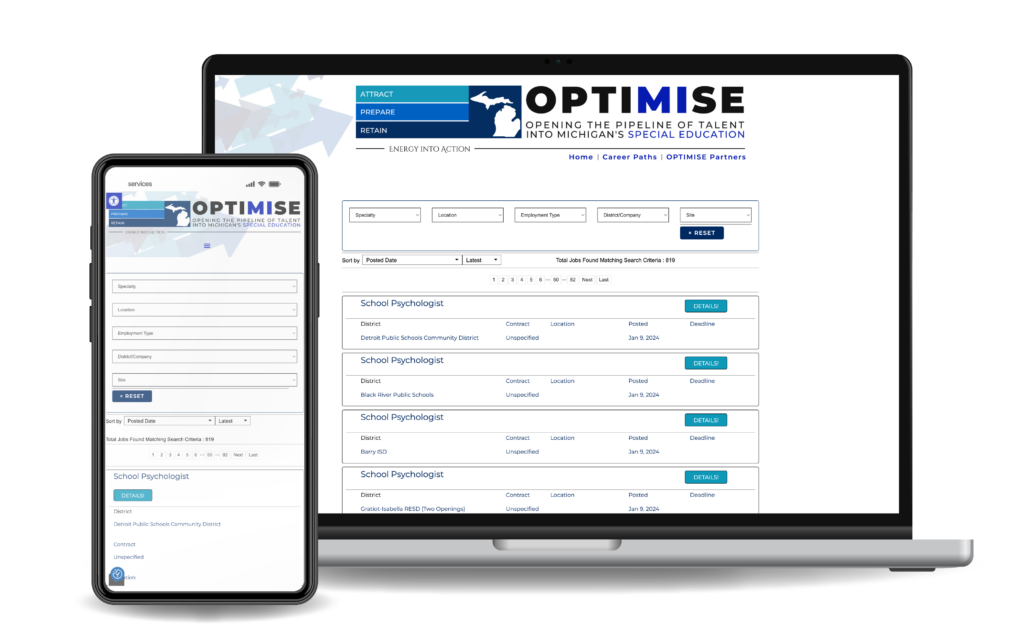
Great Special Education Transition Coordinator Jobs in Michigan

How to Become a Special Education Transition Coordinator:
Step 1: Earn a bachelor’s degree in special education or a related field.
Step 2: Complete a minimum of three years of experience in special education, transition planning, vocational rehabilitation, or a related field.
Step 3: Michigan Transition Coordinator Approval (MARSE R 340.1799G) – must be received by the Michigan Department of Education, Office of Special Education (MDE, OSE) during the school year (July 1 to June 30) in which the effective date applies.
Questions regarding placement, assignment, role, and services allowed for individuals working under either of these options should be directed to the Office of Special Education at [email protected].
Volunteer to Gain More Experience!
Get hands-on experience and find a classroom near you that is in need of a volunteer!
Job Shadow a Special Education Transition Coordinator
Each school district has their own policy when it comes to job shadowing, but you may need a state ID or a driver’s license to participate.
College Program Information
Click a point on the map to find degree programs, scholarships, grants, and organizations to join!
Special Education Transition Coordinator Educational Funding
Free College Opportunities
Allows students to earn college credit (up to 10 courses) while in high school at no cost between 9th-12th grade. The classes that students are eligible for must not be offered by the high school or PSA and must lead towards postsecondary credit, accreditation, certification, and/or licensing.
How to apply – Students are to talk with their high school advisor on eligibility, application, deadlines, and college course options.
A Michigan Department of Education approved five-year program of study.
EMCs work closely with certain colleges to provide students with an opportunity earn a high school diploma and one or more of the following:
- 60 transferable college credits.
- An associate degree.
- A professional certification.
- The Michigan Early Middle College Association (MEMCA) technical certificate.
- Participation in a registered apprenticeship.
The Michigan Achievement Scholarship is designed to help students pursue their dreams, goals, and aspirations in the Mitten State! Graduating high school seniors are eligible to earn a skill certificate or degree at their local community college tuition-free just by filling out the new and simplified FAFSA.
State Scholarships & Grants
Talent Together helps you become a certified teacher. The program also helps elevate the professional credentials of existing teachers with “add-on endorsements” and mentorship training to be a lead with “teacher apprentices” at the school district.”
Michigan Reconnect is a scholarship program that pays you to attend your in-district community college tuition free or pays up to the in-district rate if you attend a community college where you’re considered out-of-district. Applicants must be 25 years old to apply.
Thirteen Promise Zones have already begun awarding scholarships. Educators, businesses, families and civic leaders are also striving to embed a pervasive culture of learning in these communities – an essential ingredient in any recipe for education success.
Amount: up to $800
Amount: $10,000
Amount: $9,600 Stipend
Amount: $2,000 – $5,500
Federal Scholarships & Grants
Colleges and career schools use the FAFSA form to determine how much financial aid you’re eligible to receive, which could include grants, scholarships, work-study funds, and loans.You must apply for aid every year.
The Federal Student Aid Estimator provides an estimate of how much federal student aid the student may be eligible to receive. These estimates are based on the Student Aid Index (SAI), an index to determine federal student aid eligibility.
Direct Subsidized Loans and Direct Unsubsidized Loans are federal student loans offered by the U.S. Department of Education (ED) to help eligible students cover the cost of higher education at a four-year college or university, community college, or trade, career, or technical school.
A federal grant for undergraduate students with financial need.
Amount: up to $17,500
If you’re employed by a government or not-for-profit organization, you might be eligible for the PSLF Program. The PSLF Program forgives the remaining balance on your Direct Loans
*Borrowers can’t receive credit toward TLF and Public Service Loan Forgiveness (PSLF) for the same period of service. That means, if you seek and receive TLF, the five-year period of service that supported your eligibility will NOT count toward PSLF. We recommend that you consider whether you’re interested in PSLF before deciding to pursue TLF, because we can’t make changes once you receive forgiveness.
Direct PLUS loans can help pay for education expenses not covered by other financial aid. The U.S. Department of Education makes Direct PLUS Loans to eligible graduate or professional students through schools participating in the Direct Loan Program.
Grant for undergraduate students with exceptional financial need, administered directly by financial aid office at each participating school, not all schools participate
part-time employment while enrolled in school, available to undergrad, grad, and professional students with financial need, available to full and part-time students, administered by participating schools, emphasizes employment in civic education and work related to course of study or civic education, on or off campus
Amount: up to $4,000/year
Special Education Transition Coordinator Story Tellers
Below are videos highlighting special education transition coordinators throughout Michigan.
Watch to find out why they love the profession!